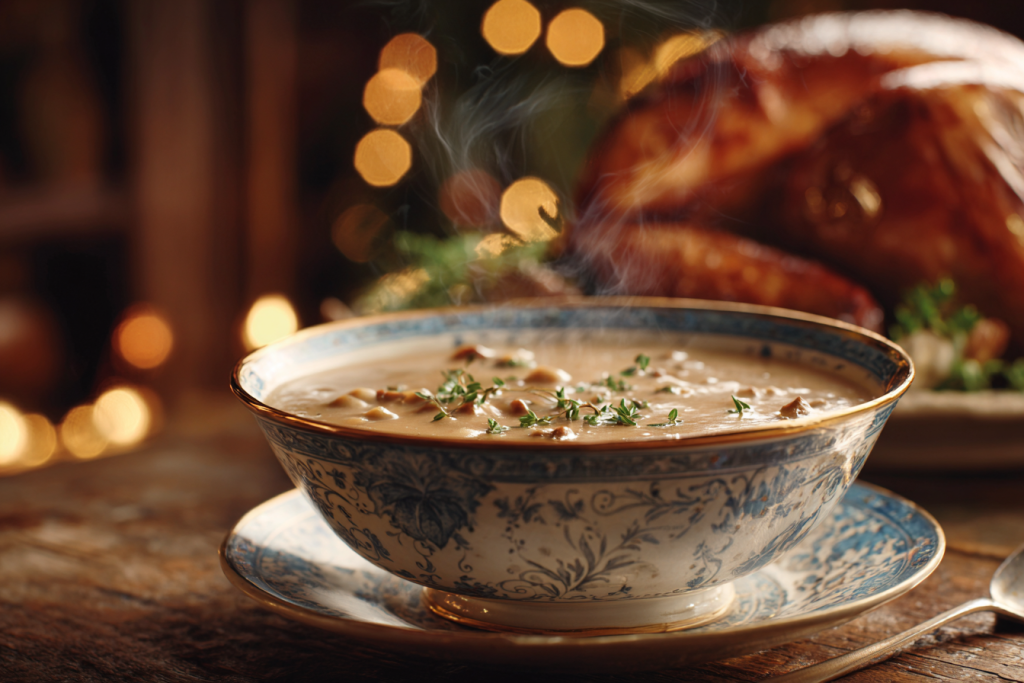
This step-by-step guide on How to Make Giblet Gravy turns humble turkey parts into a rich, liquid gold that will quiet the whole room.
By mastering the simple “three pillars” method—stock, drippings, and roux—you will banish lumpy, greasy sauces forever and create a velvety finish that honors the centerpiece of your meal. Use this savory sauce to smother a hot plate of Fluffy Buttermilk Biscuits for the ultimate comfort food experience.
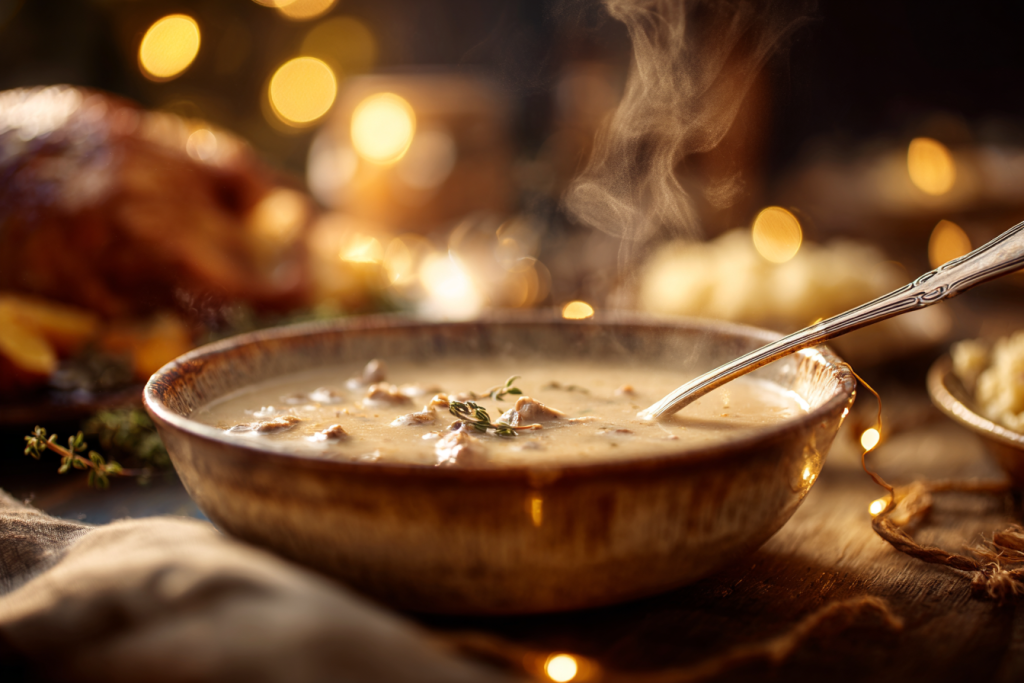
My No-Fail Guide to Making Rich, Old-Fashioned Giblet Gravy
The turkey is resting, the potatoes are steaming, and all eyes are on you for one thing: the gravy. For so many good home cooks, this is the moment the kitchen jitters set in. What if it’s lumpy? What if it’s greasy? What if it tastes… like nothing? That little packet of giblets tucked inside the turkey can feel more like a puzzle than a gift.
Take a deep breath. I’m going to walk you through, step by step, exactly how to make giblet gravy so rich and flavorful, it’ll quiet the room in the best possible way. This isn’t about fancy, complicated tricks. It’s about a time-tested process, one I’ve relied on for more holidays than I can count, that turns those humble parts into liquid gold. Your gravy is going to be perfect.
What You Need to Know for How to Make Giblet Gravy
Before we touch a single pan, let’s understand what we’re working with. Real, old-fashioned giblet gravy is built on three pillars of flavor: the giblet stock, the pan drippings, and the roux.
- The Giblet Stock: This is where that little packet shines. The neck, heart, and gizzard are simmered with vegetables to create a deep, savory broth. This broth is the body of your gravy.
- The Pan Drippings: This is the soul of your gravy. All those wonderful, browned bits and rendered fat at the bottom of your roasting pan are pure, concentrated turkey flavor.
- The Roux: This is the foundation. A simple paste of fat and flour, cooked just right, is what thickens the gravy and adds its own nutty, toasted flavor.
When these three things come together, you don’t just get a sauce—you get the heart of the meal.
The Secret to a Perfect Thanksgiving Dinner: The Giblet Stock
The very first thing I do, long before the turkey is even thinking about going into the oven, is start my stock. You can even do this a day ahead, which I highly recommend.
Place the turkey neck, heart, and gizzard into a medium saucepan. (Set the liver aside for now; we’ll talk about that special piece in a moment). Add your aromatics—a quartered onion, a carrot, a celery stalk—along with a bay leaf and a few peppercorns.
Cover it all with 4-5 cups of water or low-sodium broth and bring it to a gentle boil. Now, here is the first secret my grandmother taught me: as soon as it boils, turn the heat down to a whisper. A rolling boil makes a cloudy, greasy stock, but a gentle, lazy simmer extracts all the flavor, leaving you with a clean, beautiful broth. Let it simmer, covered, for at least an hour. You’ll know it’s ready when the whole house starts to smell like a Thanksgiving or Christmas holiday.
Preparing the Giblets and Finishing the Stock
While that stock is simmering, let’s talk about the liver. The liver is special. It’s too delicate to be boiled; it would turn bitter and tough. Instead, I like to sauté it in a tiny bit of butter for just a few minutes until it’s just-cooked-through. Then, chop it very fine and set it aside.
Once your stock has simmered for an hour or so, the meat on the neck and the giblets will be perfectly tender. Use a slotted spoon to lift them out and set them on a cutting board to cool.
Pour the stock through a fine-mesh strainer into a large bowl or measuring cup. You can discard those vegetables; they’ve given all they have to give. When the neck meat and giblets are cool enough to handle, pick all the meat off the neck and finely chop it, along with the heart and gizzard. Add this chopped meat (and the reserved liver) to a bowl, and you’re ready for the main event.
Pro-Tip: A Note on Fat, The Flavor Foundation
When your turkey is done and you pour the drippings into a measuring cup, let it stand for 5-10 minutes. The fat will rise right to the top. That clear, golden fat is what we’ll use for our roux. The recipe calls for 1/4 cup, but I scrape every bit of it into a little jar. Any extra is wonderful for roasting potatoes or sautéing green beans. Don’t you dare throw it out. If you don’t have enough fat from your drippings (it happens!), a good quality unsalted butter is your next best friend.
The Most Important Step: Building Your Roux
This is the part that frightens most people, but it’s simple when you know the “why.” A roux is just equal parts fat and flour, and it’s what will thicken our gravy.
Place your large skillet or the roasting pan itself (my preference) over medium heat. Add your 1/4 cup of reserved turkey fat or butter. Once it’s melted and shimmering, sprinkle in 1/4 cup of all-purpose flour and start whisking immediately.
It will bubble and look a bit like wet sand. Keep whisking. This is where you cook out that raw, pasty flour taste. After about 3-5 minutes, the roux will smooth out, turn a beautiful light peanut butter color, and smell nutty and warm. That’s when you know it’s ready. Don’t rush this step; it’s the non-negotiable secret to a professional-tasting gravy.
How to Get Lump-Free Giblet Gravy Every Time
Here is the second secret, the one that guarantees a smooth, velvety gravy: add warm stock to your roux, and add it slowly at first.
Your roux is hot, and your strained giblet stock should be warm (you can pop it in the microwave for a minute). Slowly pour about one cup of the warm stock into the roux while whisking as fast as you can.
Now, don’t panic. The mixture is going to seize up, bubble furiously, and look like a thick, ugly paste. This is supposed to happen! It’s the flour blooming. Keep whisking, and as it smooths out, start gradually pouring in the rest of your giblet stock and all those dark, savory pan drippings (the “jus” at the bottom of your measuring cup).
Keep whisking and let the gravy come to a beautiful simmer. It will thicken right before your eyes. This is the perfect time to stir in all that wonderful, reserved chopped giblet meat.
Finishing and Seasoning: The Final Touches
Your gravy is thick, it’s smooth, and it’s full of meat. Now comes the most important part of any recipe: tasting.
Give it a taste. Is it salty enough? Pan drippings can be very salty or not salty at all. Add your salt and a good bit of freshly ground black pepper, a little at a time, until the flavors just sing. A gravy without enough salt just tastes… brown. A gravy with the right amount of salt tastes like the best parts of the cornbread stuffing and turkey combined.
Want one last little secret? For a silky, restaurant-quality finish, turn the heat to low and whisk in a tablespoon or two of cold butter right at the end. It emulsifies into the gravy and gives it a beautiful, velvety sheen.
Pro-Tip: The Liver Debate… My Two Cents
Some folks find the liver a bit too strong, and that’s just fine. You can leave it out completely, and your gravy will be wonderful. But if you want that truly deep, old-fashioned, savory flavor… sautéing it and chopping it fine is the secret. It almost dissolves into the gravy, adding an iron-rich depth you just can’t get any other way. I’d encourage you to try it just once.
Another Pro-Tip: Sliced Boiled Eggs
I was taught to add slices of boiled eggs in my giblet gravy, this gives a nice texture to offset the stuffing. The yolks in particular provide a super yummy taste that is just “slap yo woman with a backhand bum pop” dag num it that tastes good (as my paw paw used to say)! Some folks don’t like eggs in their giblet gravy, but if you’ve never tried it than slice 2 boiled eggs, and gently stir them whites into the gravy once the gravy is done. Then lay the sliced yolks on top.
Common Gravy Mistakes (And How to Fix Them)
After decades of making gravy, I’ve seen it all. The good news is that almost any mistake is fixable.
- “My gravy is lumpy!”
- The Fix: You added your liquid too fast. Don’t worry. Just pour the whole thing through your fine-mesh sieve into another pot. Your secret is safe with me. An immersion blender on low will also smooth it out in seconds.
- “My gravy is greasy!”
- The Fix: You didn’t skim enough fat. Let the gravy stand off the heat for a few minutes. The fat will rise, and you can gently skim it off with a wide spoon.
- “My gravy is bland!”
- The Fix: It needs salt! That’s almost always the answer. Add salt, a little at a time, until it tastes right. If it’s still missing “something,” a tiny splash of soy sauce or Worcestershire can add a wonderful umami boost.
- “My gravy is too thin!”
- The Fix: Let it simmer for another 5-10 minutes; it will reduce and thicken. If you’re in a real hurry, mix 1 tablespoon of cornstarch with 1 tablespoon of cold water to make a “slurry,” then whisk it into the simmering gravy.
What to Do With Leftover Gravy
If you’re lucky enough to have leftovers, store your cooled gravy in an airtight container in the refrigerator for up to 3 days. It will turn very thick and gelatinous when cold—that’s a good sign! It means you made a real, rich stock.
To reheat, put it in a small saucepan over low heat and whisk it gently. You will likely need to add a splash of water or broth to thin it back out to its original, pourable consistency. Be patient and don’t boil it. When it comes to storing Holiday leftovers, it’s always best to be safe.
Of course, the best use for leftover gravy is a hot turkey sandwich: just a slice of good bread, a pile of leftover turkey, and a generous pour of hot gravy over the whole thing. It’s the best part of a classic Holiday brunch!
Flavor Variations:
Mushroom: Sauté 8 oz of finely chopped mushrooms (cremini or shiitake) in the fat before adding the flour.
Herbaceous: Add a sprig of rosemary and a few sprigs of thyme along with the bay leaf when making the stock.
Creamy: Stir in 1/4 cup of heavy cream or half-and-half at the very end for a richer, paler gravy.
Pairings: This is a must-have for any traditional holiday spread, pairing perfectly with roasted turkey, chicken, or pork, alongside cranberry sauce, green bean casserole, and sweet potato pie.
Troubleshooting Tips:
My gravy is lumpy: You added the liquid too fast or it wasn’t warm enough. Fix it by pouring the gravy through a fine-mesh sieve or using an immersion blender for a few seconds.
My gravy is too thin: It needs to simmer longer. If you’re in a hurry, make a “slurry” by mixing 1 tbsp of cornstarch with 1 tbsp of cold water, then whisk it into the simmering gravy.
My gravy is too thick: Whisk in more warm broth or water, a little at a time, until it reaches the right consistency.
My gravy is bland: It needs more salt! Or add a splash of soy sauce or Worcestershire for a quick umami boost.
Leftover Transformation Ideas:
Hot Turkey Sandwiches: The absolute best use. Serve open-faced on toast with leftover turkey, all smothered in reheated gravy.
Poutine: Drizzle over french fries and cheese curds.
Shepherd’s Pie: Use as the base for a turkey shepherd’s pie, topped with leftover mashed potatoes.
Make-Ahead: You can make the giblet stock up to 3 days in advance and store it in the fridge. You can even make the entire gravy a day ahead, but you’ll miss out on the fresh pan drippings. My advice: make the stock ahead, and make the gravy itself while the turkey is resting.
Substitutions:
No Drippings? No problem. You won’t have the exact same flavor, but you can make a great gravy. Use 1/4 cup of butter for your roux and use 4-5 cups of your giblet stock plus 1-2 tablespoons of soy sauce or Worcestershire for depth.
Don’t like giblets? You can still make the “stock” with just the neck and aromatics (onion, carrot, celery) and skip adding the chopped meat at the end.
Scaling: This recipe can easily be doubled for a very large crowd. Just use a larger pot and skillet, and ensure you have enough stock/broth.
You Can Do This
And there you have it. You didn’t just make gravy; you made the best, most flavorful part of the meal. You honored that turkey by using every wonderful bit of it, and you’ve created something truly special from scratch.
When you bring that beautiful gravy boat to the table, I want you to feel nothing but pride. This is a recipe built on patience and love. You’ve earned it.
The Ultimate Holiday Giblet Gravy: From Package to Perfection
Equipment
- Medium saucepan or pot
- Fine-mesh sieve or strainer
- Cutting board
- Chef's knife
- Large liquid measuring cup (preferably a fat separator)
- Large skillet or roasting pan (for the roux and finishing)
- Whisk
- Wooden Spoon
Ingredients
For the Giblet Stock:
- Giblets neck, heart, gizzard from 1 turkey (liver set aside)
- 1 medium onion quartered
- 1 large carrot cut into chunks
- 1 celery stalk cut into chunks
- 1 bay leaf
- 1/2 tsp black peppercorns
- 4-5 cups water or low-sodium chicken broth
For the Gravy:
- 4-6 cups drippings from your roast turkey deglazed with 1/2 cup white wine or water
- 1/4 cup reserved turkey fat skimmed from drippings or unsalted butter
- 1/4 cup all-purpose flour
- Turkey liver optional, for richer flavor
- 1-2 tbsp unsalted butter optional, for finishing
- Salt and freshly ground black pepper to taste
- 1 tbsp fresh herbs finely chopped (e.g., sage, thyme, parsley) - optional
Instructions
Make the Giblet Stock:
- Place the turkey neck, heart, and gizzard in a medium saucepan. Add the onion, carrot, celery, bay leaf, and peppercorns.
- Pour in the 4-5 cups of water or broth, ensuring everything is covered.
- Bring to a boil, then reduce the heat to low, cover, and simmer gently for 1 to 1.5 hours. The meat should be very tender.
- Tester's Note: Don't boil this aggressively! A gentle simmer extracts flavor without making the stock cloudy. I've learned that patience here is the key to a non-greasy, flavorful base.
Prepare the Giblets:
- While the stock simmers, prepare the liver if using. Sauté the turkey liver in 1 tsp of butter for 2-3 minutes per side until just cooked through. Finely chop it and set it aside.
- Once the stock is done, use a slotted spoon to remove the neck, heart, and gizzard. Strain the stock through a fine-mesh sieve into a bowl; discard the vegetables. You should have about 3-4 cups of rich stock.
- When the cooked giblet meats are cool enough to handle, pick all the meat off the neck and finely chop it along with the heart and gizzard. Set this chopped meat aside.
De-Fat the Drippings:
- Pour all the drippings from your turkey roasting pan into a large liquid measuring cup or a fat separator.
- Let it stand for 5-10 minutes. The fat will rise to the top. Skim off 1/4 cup of this clear yellow fat and set it aside. This is your "liquid gold" for the roux.
- The remaining dark, savory drippings (the "jus") will be used for the gravy.
Make the Roux:
- Place the large skillet or roasting pan (that you cooked the turkey in, if you like) over medium heat.
- Add the 1/4 cup of reserved turkey fat (or use butter if you didn't have enough fat).
- Sprinkle the 1/4 cup of flour over the fat and immediately start whisking.
- Cook the roux, whisking constantly, for 3-5 minutes. It will bubble and then smooth out. You want it to turn a light peanut butter color and smell nutty.
- My Hard-Won Tip: Do not rush this step. Cooking the flour for at least 3 minutes gets rid of that "raw flour" taste. I've made this gravy over 20 times, and this is the non-negotiable step for a professional-tasting gravy. A darker roux means a darker, more complex gravy.
Build the Gravy:
- Slowly—very slowly at first—pour about 1 cup of the warm giblet stock into the roux, whisking vigorously. The mixture will seize up and look like a thick paste. This is normal!
- Keep whisking and gradually pour in the rest of the giblet stock and all the reserved turkey drippings (the jus, not the fat).
- Bring the gravy to a simmer, whisking often, until it thickens enough to coat the back of a spoon (about 5-10 minutes).
Finish and Season:
- Stir in the reserved chopped giblet meat and the optional chopped liver.
- Taste the gravy. This is the most important part. Add salt and pepper as needed. Roasting drippings vary wildly in saltiness, so always taste before you season.
- For a silky, restaurant-quality finish, turn the heat to low and whisk in 1-2 tablespoons of cold butter until it melts. This is a classic technique called monter au beurre.
- Stir in the fresh herbs (if using) just before serving.
Notes
Nutrition
Rate This Recipe
Share This Recipe With The Ones You Love!