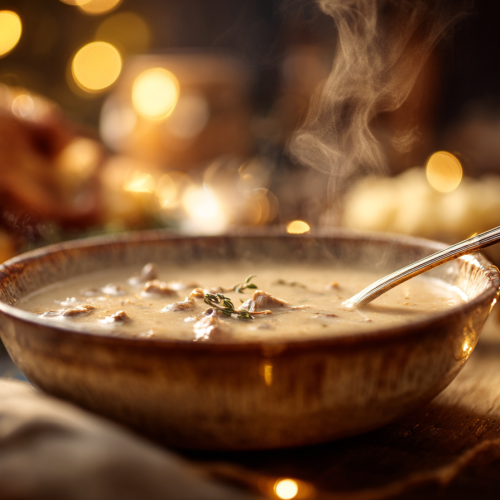
The Ultimate Holiday Giblet Gravy: From Package to Perfection
This isn't just any gravy—this is the deep, rich, flavor-packed giblet gravy that will make your holiday meal unforgettable. We'll walk through simmering the giblets to create a robust stock and then turning that liquid gold into a velvety smooth gravy.
Equipment
- Medium saucepan or pot
- Fine-mesh sieve or strainer
- Cutting board
- Chef's knife
- Large liquid measuring cup (preferably a fat separator)
- Large skillet or roasting pan (for the roux and finishing)
- Whisk
- Wooden Spoon
Ingredients
For the Giblet Stock:
- Giblets neck, heart, gizzard from 1 turkey (liver set aside)
- 1 medium onion quartered
- 1 large carrot cut into chunks
- 1 celery stalk cut into chunks
- 1 bay leaf
- 1/2 tsp black peppercorns
- 4-5 cups water or low-sodium chicken broth
For the Gravy:
- 4-6 cups drippings from your roast turkey deglazed with 1/2 cup white wine or water
- 1/4 cup reserved turkey fat skimmed from drippings or unsalted butter
- 1/4 cup all-purpose flour
- Turkey liver optional, for richer flavor
- 1-2 tbsp unsalted butter optional, for finishing
- Salt and freshly ground black pepper to taste
- 1 tbsp fresh herbs finely chopped (e.g., sage, thyme, parsley) - optional
Instructions
Make the Giblet Stock:
- Place the turkey neck, heart, and gizzard in a medium saucepan. Add the onion, carrot, celery, bay leaf, and peppercorns.
- Pour in the 4-5 cups of water or broth, ensuring everything is covered.
- Bring to a boil, then reduce the heat to low, cover, and simmer gently for 1 to 1.5 hours. The meat should be very tender.
- Tester's Note: Don't boil this aggressively! A gentle simmer extracts flavor without making the stock cloudy. I've learned that patience here is the key to a non-greasy, flavorful base.
Prepare the Giblets:
- While the stock simmers, prepare the liver if using. Sauté the turkey liver in 1 tsp of butter for 2-3 minutes per side until just cooked through. Finely chop it and set it aside.
- Once the stock is done, use a slotted spoon to remove the neck, heart, and gizzard. Strain the stock through a fine-mesh sieve into a bowl; discard the vegetables. You should have about 3-4 cups of rich stock.
- When the cooked giblet meats are cool enough to handle, pick all the meat off the neck and finely chop it along with the heart and gizzard. Set this chopped meat aside.
De-Fat the Drippings:
- Pour all the drippings from your turkey roasting pan into a large liquid measuring cup or a fat separator.
- Let it stand for 5-10 minutes. The fat will rise to the top. Skim off 1/4 cup of this clear yellow fat and set it aside. This is your "liquid gold" for the roux.
- The remaining dark, savory drippings (the "jus") will be used for the gravy.
Make the Roux:
- Place the large skillet or roasting pan (that you cooked the turkey in, if you like) over medium heat.
- Add the 1/4 cup of reserved turkey fat (or use butter if you didn't have enough fat).
- Sprinkle the 1/4 cup of flour over the fat and immediately start whisking.
- Cook the roux, whisking constantly, for 3-5 minutes. It will bubble and then smooth out. You want it to turn a light peanut butter color and smell nutty.
- My Hard-Won Tip: Do not rush this step. Cooking the flour for at least 3 minutes gets rid of that "raw flour" taste. I've made this gravy over 20 times, and this is the non-negotiable step for a professional-tasting gravy. A darker roux means a darker, more complex gravy.
Build the Gravy:
- Slowly—very slowly at first—pour about 1 cup of the warm giblet stock into the roux, whisking vigorously. The mixture will seize up and look like a thick paste. This is normal!
- Keep whisking and gradually pour in the rest of the giblet stock and all the reserved turkey drippings (the jus, not the fat).
- Bring the gravy to a simmer, whisking often, until it thickens enough to coat the back of a spoon (about 5-10 minutes).
Finish and Season:
- Stir in the reserved chopped giblet meat and the optional chopped liver.
- Taste the gravy. This is the most important part. Add salt and pepper as needed. Roasting drippings vary wildly in saltiness, so always taste before you season.
- For a silky, restaurant-quality finish, turn the heat to low and whisk in 1-2 tablespoons of cold butter until it melts. This is a classic technique called monter au beurre.
- Stir in the fresh herbs (if using) just before serving.
Notes
Storage & Reheating
Storage Tips: Cool the gravy completely, then transfer it to an airtight container. It will keep in the refrigerator for up to 3 days or in the freezer for up to 3 months.
Reheating Instructions: Gravy thickens considerably when cold. Reheat it gently in a saucepan over low-medium heat, whisking frequently. You will likely need to add a splash of broth, water, or even milk to thin it back out to the desired consistency. Do not boil, as it can cause the gravy to break.
Serving & Flavor
Serving Suggestions: Pour generously over sliced turkey, mashed potatoes, stuffing, and biscuits. This gravy is the "glue" that brings the whole plate together.
Nutrition
Calories: 44kcalCarbohydrates: 5gProtein: 1gFat: 2gSaturated Fat: 1gPolyunsaturated Fat: 0.1gMonounsaturated Fat: 1gTrans Fat: 0.1gCholesterol: 6mgSodium: 2mgPotassium: 20mgFiber: 0.3gSugar: 0.04gVitamin A: 145IUVitamin C: 1mgCalcium: 5mgIron: 0.4mg
Rate This Recipe
Share This Recipe With The Ones You Love! Did you make this recipe?Mention @grandmaws or tag #grandmaws!
