There is nothing sadder than a beautiful batch of biscuits going to waste because you made too many and did not know what to do with the extras. I have been freezing biscuits for longer than most people have been alive, and I can tell you right now — yes, you absolutely can freeze them. But how you freeze them and what form they are in when they go into that freezer makes all the difference between a biscuit that comes back to life and one that comes out like a little hockey puck.
I learned this the hard way, decades ago, when I froze a whole pan of leftover biscuits just tossed into a bag. They came out dry, crumbly, and tasted like the inside of my freezer. That was the last time I ever did it without thinking it through. Since then, I have tested every method I could think of — freezing the dough before baking, freezing biscuits after they come out of the oven, wrapping them one way versus another — and I have landed on a system that works every single time.
The short answer is that both dough and baked biscuits freeze well, but they are not the same thing when they come back. Frozen dough gives you that fresh-from-the-oven experience any morning of the week. Frozen baked biscuits give you something warm and ready in minutes when you do not have time to roll and cut. Both have a place in my kitchen, and by the time you finish reading this, you will know exactly when to use each one and how to do it right.
Why Freezing Biscuits Works So Well
Biscuits are one of the most freezer-friendly things you will ever make, and the reason comes down to what they are made of. Flour, fat, and a little liquid — that is a combination that holds up beautifully in cold storage. The fat, whether it is butter or lard or shortening, acts almost like a protector. It keeps the moisture locked in and prevents that dried-out, stale texture you get when you freeze something like plain bread.
I have pulled biscuit dough out of my freezer after two months and baked it up just as tall and flaky as the day I made it. I have also pulled baked biscuits out after six weeks and warmed them in the oven and had my grandchildren ask me if I just made them. The key is not whether biscuits can survive the freezer — they can. The key is how you get them in there and how you bring them back.
Now, there is a difference between “it survived the freezer” and “it tastes like it was never in there.” That difference is all in the wrapping, the timing, and the reheating. I am going to walk you through both methods so you know exactly what to expect from each one.
Freezing Biscuit Dough: The Method That Gives You Fresh Biscuits Any Day of the Week
This is my favorite method, and it is the one I use most. When I make biscuits, I almost always make a double batch now. I bake what I need for that meal, and the rest goes straight into the freezer as dough. The reason I love this so much is that there is nothing — and I mean nothing — that compares to a biscuit that goes into the oven as dough and comes out hot and fresh. Reheated biscuits are fine. But a biscuit baked from frozen dough tastes like you just made it from scratch, because in a way, you did.
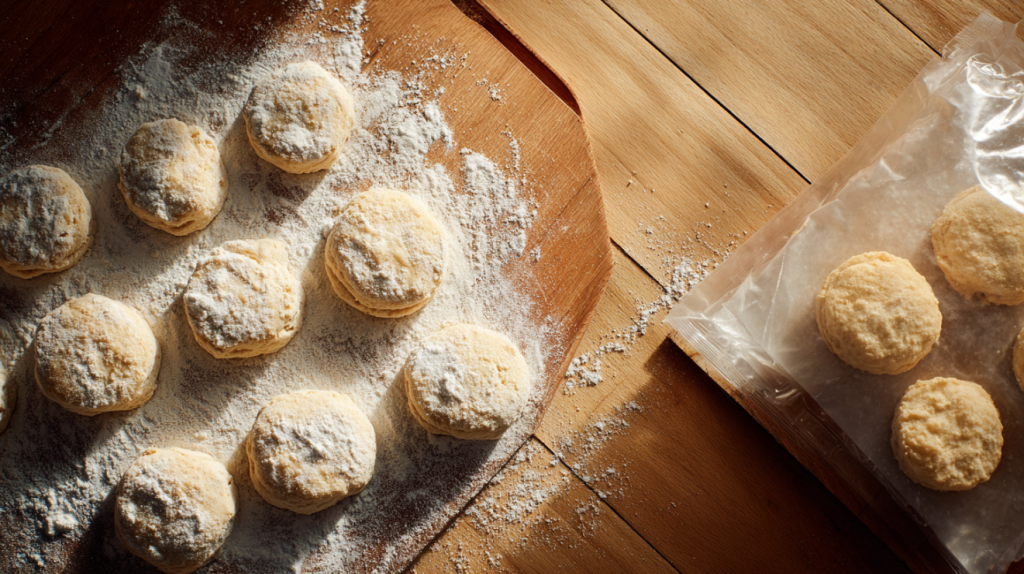
Here is exactly how I do it. I make my biscuit dough the way I always do. I cut them out, and the ones that are not going in the oven right now go onto a baking sheet lined with parchment paper. I set them on that sheet so they are not touching each other — about an inch apart is fine — and I put the whole sheet in the freezer. This is what some people call flash freezing, and it is the most important step. You want each biscuit to freeze individually so they do not stick together in a big clump.
After about two hours, sometimes three if they are thick, those dough rounds will be frozen solid. That is when I take them off the sheet and transfer them into a freezer bag. I press out as much air as I can before I seal it. Some people use a straw to suck the air out, and that works just fine. The less air in that bag, the longer those biscuits will taste fresh.
When you are ready to bake, you do not need to thaw them first. That is one of the beautiful things about this method. Take out as many frozen dough rounds as you need, put them on a baking sheet, and put them straight into a preheated oven. The only change you make is adding a few extra minutes to your baking time. If your biscuits normally take twelve to fourteen minutes, frozen dough will need about sixteen to twenty. You will know they are done the same way you always know — the tops are golden, the bottoms are set, and your kitchen smells like heaven.
I do want to say one thing about the dough itself. This method works best with a dough that has a good amount of fat in it. If you are making Perfect Southern Biscuits: A Step-by-Step Guide, the kind with cold butter or lard cut into soft flour, that dough freezes beautifully because the fat is already in solid pieces throughout the dough. When it hits the hot oven, those little pockets of fat melt and create steam, and that is what gives you layers. Starting from frozen actually helps with that because the fat stays colder longer, which means more steam, which means taller, flakier biscuits.
Freezing Baked Biscuits: The Quick-Warm Method for Busy Mornings
Now, sometimes you have leftover biscuits from supper and you do not want to waste them. Or maybe you baked a big batch specifically so you could have ready-made biscuits in the freezer for those mornings when you do not have thirty minutes to roll and bake. That is where freezing baked biscuits comes in, and it works well as long as you do it right.
The most important rule is this — let those biscuits cool completely before they go anywhere near a bag or the freezer. If you put a warm biscuit in a bag, the steam gets trapped inside, turns to moisture, and then turns to ice crystals. Those ice crystals are what make a biscuit soggy and sad when you reheat it. So let them sit on a wire rack until they are room temperature all the way through. I usually give mine at least an hour.
Once they are cool, I wrap each biscuit individually in aluminum foil. Then I put the wrapped biscuits into a freezer bag, press the air out, and seal it. The foil gives you an extra layer of protection against freezer burn, and it also makes reheating easier because you can put a foil-wrapped biscuit straight into the oven.
Baked biscuits keep well in the freezer for about four to six weeks. They will still be safe to eat after that, but the texture starts to go. The outside gets a little chewy, the inside gets a little dry, and they just do not taste the way they should. I try to use mine within a month for the best results.
How to Reheat Frozen Baked Biscuits the Right Way
This is where most people go wrong, and I understand why. It is tempting to throw a frozen biscuit in the microwave for thirty seconds and call it done. And sure, it will be warm. But it will also be rubbery on the outside and still a little cold in the middle, and that is not what a biscuit is supposed to be.
The oven is always your best choice. Take the biscuit out of the freezer — you can leave it in the foil or take it out, either way — and put it in an oven preheated to 350 degrees. If it is wrapped in foil, give it about fifteen to twenty minutes. If it is unwrapped, twelve to fifteen minutes will do. You want the outside to be warm and just barely crisp again, and the inside to be soft and heated through.
If you are in a real hurry, the air fryer does a respectable job. Set it to 325 degrees and give the biscuit about five to eight minutes. The air fryer tends to crisp the outside a little more than the oven does, which some people actually prefer. Just keep an eye on it because every air fryer runs a little different, and a biscuit can go from warm to overdone in a hurry. If you want more detail on reheating all kinds of Southern staples, I go into that in How to Reheat Southern Classics: Fried Chicken, Biscuits, Mac & Cheese.
The microwave is my last resort, and I only use it when I truly have no other option. If you must microwave a frozen biscuit, wrap it in a damp paper towel first. That little bit of moisture helps keep it from drying out. Heat it for about thirty to forty-five seconds, check it, and go another fifteen seconds if needed. It will not be as good as the oven, but it will be edible.
Dough vs. Baked: Which One Should You Choose?
I get asked this question more than almost any other biscuit question, and the honest answer is that I keep both in my freezer at all times. But they serve different purposes, and once you understand that, the choice is easy.
Freeze the dough when you want fresh-baked biscuits without the work of mixing and cutting. Saturday morning, Sunday dinner, a weeknight when you just want something warm and homemade with your soup or stew — pull out a few frozen dough rounds and bake them. They will taste like you made them from scratch that very hour. This is also the better method if you are someone who cares deeply about texture. A biscuit baked from frozen dough will have better rise, better layers, and a better crust than a reheated one. Every time.
Freeze baked biscuits when you need something fast. Breakfast on a school morning, a quick snack, a biscuit for the road with some ham or sausage tucked inside — that is when a pre-baked frozen biscuit earns its place. You are trading a little bit of texture for a lot of convenience, and sometimes that trade is worth it.
If I had to pick just one method and that was all I could do for the rest of my life, I would pick freezing the dough. The results are that much better. But I am glad I do not have to choose, and you do not either.
The Best Biscuit Recipes for Freezing
Not every biscuit recipe freezes equally well. In my experience, the richer the dough, the better it holds up. Biscuits with a generous amount of butter or lard and a good splash of buttermilk freeze the best because all that fat and moisture protects the dough in the freezer.
My buttermilk biscuits — the ones I have been making since I was tall enough to reach the counter — freeze beautifully. The buttermilk keeps the interior tender even after freezing, and the butter gives you those flaky layers when it bakes. If you have not tried the differences between biscuit types, I lay that all out in Angel Biscuits vs. Buttermilk Biscuits vs. Drop Biscuits, and it will help you figure out which one suits your freezing plans best.
Angel biscuits, the ones made with yeast in addition to baking powder, are actually one of the best freezers of the bunch. That yeast gives the dough a little extra rise power that holds up well over time. I have frozen angel biscuit dough for six weeks and had them bake up just as puffy and light as fresh.
Drop biscuits — the quick, no-roll kind — are a little trickier. You can freeze the baked ones just fine, but freezing the dough is harder because it is so wet and sticky. If you want to freeze drop biscuit dough, scoop it out with an ice cream scoop onto your parchment-lined sheet and flash freeze the scoops. They will be a little more rustic looking when they bake, but they taste just right. For the simplest version, The 3-Ingredient Drop Biscuit for Emergencies works surprisingly well from frozen.
One thing I would avoid freezing is any biscuit that has a lot of cheese or fresh herbs mixed into the dough. Cheese changes texture when it freezes and thaws, getting a little grainy, and fresh herbs lose their brightness. Those biscuits are best made and eaten the same day.
Common Mistakes People Make When Freezing Biscuits
I have seen just about every mistake there is when it comes to freezing biscuits, and I have made a few of them myself over the years. Here are the ones that will ruin your results if you are not careful.
The biggest mistake is skipping the flash freeze step with dough. If you dump your freshly cut dough rounds straight into a bag, they will freeze into one solid mass. You will not be able to pull out just two or three — you will have to thaw the whole bag or try to pry them apart with a knife, and that never ends well. Always freeze them on a sheet first, then bag them.
The second biggest mistake is not getting the air out of your freezer bags. Air is the enemy. Air is what causes freezer burn, and freezer burn is what makes your biscuits taste like they have been sitting in an old ice chest for a month. Press every bit of air out of that bag before you seal it. If you are serious about freezer storage, a vacuum sealer is worth every penny. I talk more about smart freezing strategies in The 5 Biggest Mistakes You’re Making When Freezing Food, and a lot of those principles apply directly to biscuits.
Another common mistake is freezing biscuits that were already a day or two old. If a biscuit is already starting to go stale on the counter, the freezer is not going to bring it back to life. It is just going to preserve it in its stale state. Freeze them when they are at their best — either as fresh dough or as freshly baked biscuits that have just cooled down. The freezer keeps things where they are. It does not make them better.
How Long Do Frozen Biscuits Last?
This depends on what you froze and how well you wrapped it. Here is what I have found from years of testing.
Frozen biscuit dough, properly wrapped with the air pressed out, keeps its best quality for about two months. I have pushed it to three months and still gotten good results, but somewhere around the two-month mark is where I notice the rise starts to weaken just a little. The biscuits are still good — they are just not quite as tall and proud as they would be at four weeks.
Frozen baked biscuits have a shorter window. I find the sweet spot is about four weeks. After six weeks, they start getting a little dry on the inside no matter how well you wrapped them. The foil and the bag help, but baked goods just do not hold up as long as raw dough in the freezer. That is one more reason I prefer freezing dough when I have the choice.
Both types are perfectly safe to eat well beyond those time frames — I am talking about quality, not safety. A biscuit that has been in the freezer for four months is not going to hurt you. It is just not going to make you close your eyes and smile the way a good biscuit should.
Batch Cooking Biscuits for the Freezer
Once you get comfortable with freezing biscuits, the next step is making it part of your routine. I set aside one morning every few weeks — usually a Saturday — and make a triple or quadruple batch of biscuit dough. I bake what I need for that weekend, and everything else goes into the freezer as dough rounds.
A quadruple batch of my buttermilk biscuits gives me about forty biscuit rounds. I bake a dozen for Saturday and Sunday, and the other twenty-eight go into the freezer. That is enough for about two weeks of biscuits any time I want them, and the total time from start to clean-up is about forty-five minutes. Compare that to making biscuits from scratch every time you want them, and you can see why I call this the smartest thing I have ever done in my kitchen.
If you are interested in this kind of approach for other foods too, I go deeper into it in How to Batch Cook and Freeze a Month’s Worth of Southern Staples. Biscuits are just the beginning — once you see how well it works, you will want to do it with everything.
The key to batch cooking biscuits is to work quickly. The longer that dough sits out on the counter, the warmer the fat gets, and warm fat means flat biscuits. I mix my dough, roll it out, cut it, and get those rounds onto the freezing sheet as fast as I can. If I am doing a really big batch and it is a warm day, I will put half the dough back in the refrigerator while I cut the first half. Keeping everything cold is the golden rule, and it matters even more when you are working with large quantities. That is one of the things I talk about in Why Cold Fat and Soft Flour Make a Better Biscuit — the temperature of your ingredients is not a suggestion, it is the whole game.
A Quick Word About Store-Bought Frozen Biscuits
I know they exist. I know they are convenient. And I am not going to stand here and tell you they are terrible, because some of them are perfectly fine in a pinch. But I will tell you this — once you start keeping your own frozen biscuit dough in the freezer, you will never reach for a can or a bag of store-bought again.
The difference is in the fat and the flour. Store-bought frozen biscuits use whatever oil or shortening is cheapest that week, and they use standard commercial flour that does not have the softness you need for a real Southern biscuit. When you make your own with good butter or lard and a soft flour like White Lily, the result is so far beyond anything that comes out of a factory that it is not even a fair comparison. I talk about why the flour matters so much in A Guide to Southern Flours: White Lily vs. All-Purpose, and it will change the way you think about every biscuit you make.
The other thing about homemade frozen dough is that you know exactly what is in it. No preservatives, no stabilizers, no ingredients you cannot pronounce. Just flour, fat, buttermilk, salt, and leavening. That is all a biscuit has ever needed, and that is all it needs now.
What Freezing Biscuits Really Means for Your Kitchen
I started freezing biscuits out of practicality. I was cooking for a big family, and there were only so many hours in the day. But what I discovered over the years is that it changed the way I thought about biscuit-making entirely. It went from something I had to plan and make time for to something that was just always available. There were always biscuits in my freezer, ready to go, and that meant there was always something warm and homemade on the table no matter how busy the day got.
That is the real gift of learning to freeze biscuits well. It is not about saving money, although it does. It is not about being efficient, although it is. It is about never having to go without that one thing that makes a meal feel like home. A pot of soup is just a pot of soup until there is a warm biscuit beside it. A plate of eggs is fine on its own, but split a hot biscuit and lay it on that plate and suddenly it is breakfast the way it is supposed to be.
My grandmother did not have a freezer for most of her life, so she made biscuits every single morning. I have a freezer, so I make them once and have them for weeks. The biscuits taste the same. The kitchen smells the same when they come out of the oven. And the feeling of putting something warm and homemade on the table — that has not changed one bit. If you are looking for more ways to build that kind of foundation in your kitchen, The Complete Guide to Southern Cooking: Techniques, Traditions & Time-Tested Wisdom is where I have gathered everything I know, and it is a good place to start.
So make your biscuits. Make more than you need. And put the rest away for a day when you need them. They will be waiting for you, and they will not let you down.