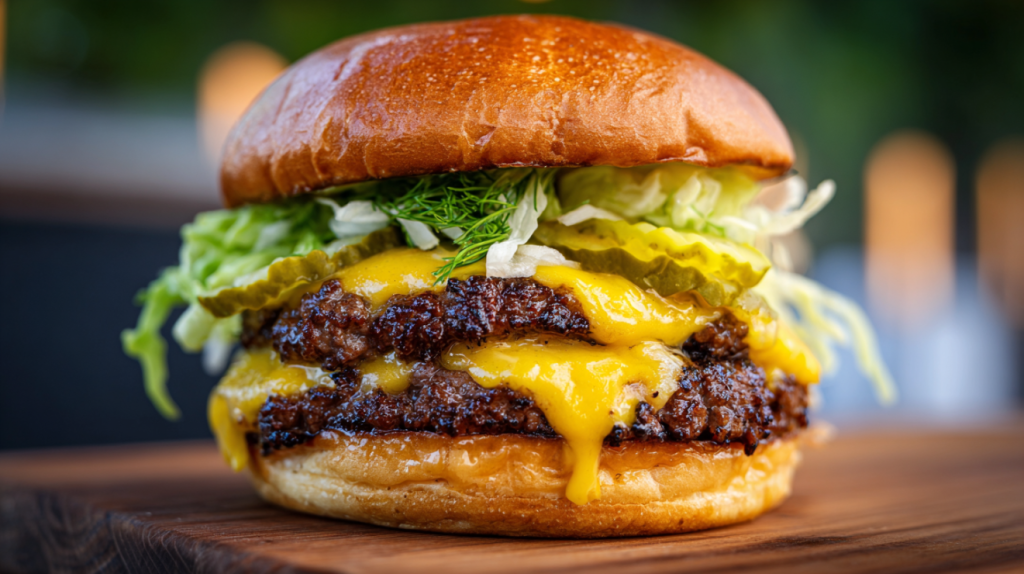
A Blackstone smash burger recipe done right is one of the most satisfying things you can cook outdoors — that thin, lacy-edged patty with a dark crust and a juicy center is something you simply cannot get from a conventional grill. Once you make these on the flat top, I promise you will wonder why you ever stood over a gas grill flipping thick patties.
I know what it is like to watch someone else make a smash burger and think it looks easy, then try it yourself and end up with something that tears apart or sticks to the griddle. The truth is there are three or four moments in this recipe where it either goes right or goes wrong, and once you know what they are, you will nail it every single time.
In this recipe, I am going to walk you through every one of those moments — what the griddle should look like before a single ball of beef goes down, how hard and fast to press, how to know when to flip without touching it early, and how to get that cheese melted and glossy in under a minute. By the time you are done reading, you will have everything you need.
Why the Blackstone Smash Burger Took Over the Backyard
The smash burger is not a new idea — it has been around in diner culture for generations. But for the longest time, home cooks did not have the right tool for it. A regular grill grate is wrong for a smash burger. The beef falls through, the grease flares up, and you cannot get even contact across the whole surface. You end up with a patty that is seared on the outside edges and steamed in the middle.
When the Blackstone flat top griddle came along and got into backyards everywhere, everything changed. That solid, heavy cooking surface is exactly what a smash burger needs. You get wall-to-wall contact between the beef and the hot steel, and that is where the magic happens. It is a reaction called the Maillard reaction — when meat proteins hit high heat, they transform into hundreds of new flavor compounds. The more contact, the more crust, the more flavor. A smash burger maximizes every bit of it.
My granddaughter brought her Blackstone over one Fourth of July, and that was the first time I made smash burgers outdoors. I had made them on a cast iron skillet indoors for years, which works beautifully — but on the Blackstone, I could cook eight patties at once, have buns toasting on one side while the beef sizzled on the other, and get everyone fed at the same time. That right there is the other gift of the flat top: you cook for a crowd without running back and forth.
If you want to understand the full range of what a flat top griddle can do for your everyday cooking, I cover it all in The Complete Guide to Southern Cooking: Techniques, Traditions & Time-Tested Wisdom.
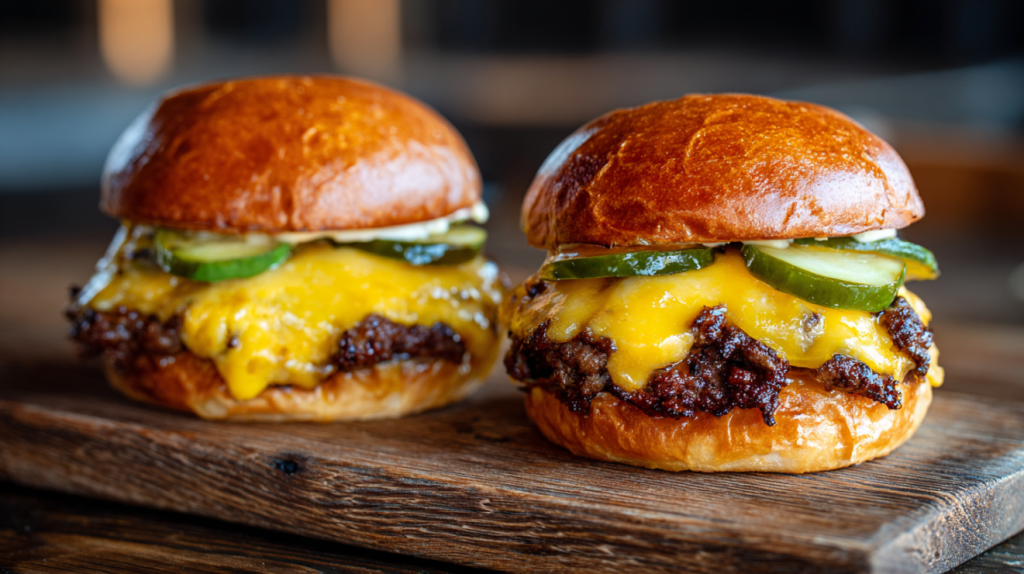
The Ingredients That Make This Burger What It Is
There are very few ingredients in a smash burger, which means every single one of them counts. The wrong ground beef will ruin the texture before the patty ever hits the griddle and the wrong cheese will not melt fast enough. The wrong bun will fall apart under the weight of the sauce. Let me tell you what I use and why.
80/20 ground beef is the only ground beef for a smash burger. That number means 80 percent lean meat and 20 percent fat, and it is that fat that does two things: it keeps the patty from drying out in the extreme heat, and it renders down into the griddle surface and helps create that crust. I have tried leaner beef — 90/10 — and the difference is noticeable right away. The patty sticks more, tears more, and ends up drier. Do not let anyone tell you to use lean beef in a smash burger. This is one of those times where fat is the whole point.
Do Not Use Processed Single Wrapped Sliced Cheese
American cheese is also non-negotiable, and I will stand by that. I know people have opinions about it, but American cheese melts in a way that no other cheese does — fast, even, and glossy. In the 30 to 45 seconds you have between flipping the patty and pulling it off the griddle, American cheese will be perfectly melted. Cheddar will be partially melted and greasy. Swiss will be rubbery. Save the fancy cheese for another dish.
Brioche buns are what I reach for because they have enough structure to hold up to the sauce without going soggy immediately, and they toast beautifully in butter. A standard white hamburger bun works too, but it compresses quickly once you load it up. Potato rolls are another good option — slightly denser and a little sweet.
The Secret Ingredient In The Smash Sauce
The smash sauce in this recipe is simple: mayonnaise, mustard, ketchup, pickle brine, hot sauce, and smoked paprika. The pickle brine is the secret — it adds a sharp, salty tang that cuts right through the richness of the beef and cheese. If you want to explore what mayonnaise brings to Southern cooking beyond burgers, I get into it in Mayonnaise: The Other Southern Fat.
Quick Substitutions:
- Ground beef: Stick with 80/20. If you must substitute, 75/25 works. Do not go leaner.
- American cheese: Pepper Jack will melt reasonably well and adds heat. Avoid natural cheeses for this application.
- Brioche buns: Potato rolls or a sturdy white hamburger bun.
- Smash sauce: Duke’s mayo mixed with a splash of pickle juice and yellow mustard is a quick version.
How to Make a Blackstone Smash Burger That Will Stop People in Their Tracks
Getting the Griddle Right Before Anything Else
This is the step most people rush, and it is the reason their burgers do not get a proper crust. Preheat your Blackstone on high for a full 8 to 10 minutes. Not 3 minutes. Not until you see a little smoke. Eight to ten minutes, high heat, until the surface is 450 to 500 degrees — hot enough that a drop of water dances and vanishes almost immediately.
Once the surface is fully hot, spread a very thin layer of neutral oil across the cooking zone using a squeeze bottle or a folded paper towel held with tongs. You want a sheen, not a puddle. Too much oil and the patties will slide instead of sear. When the oil starts to shimmer and the first whispers of smoke lift off the surface, you are ready.
Forming the Beef Balls the Right Way
Measure out your beef into 3 oz portions and roll them loosely — just barely enough pressure to hold them together. Do not pack them tight. Do not press them. The less you handle the beef, the more tender the patty will be once it is cooked. Overworked ground beef gets dense and tough, and that works against you here.
Keep them in the refrigerator on a plate until the very moment they go on the griddle. Cold beef holds its shape better during the smash. Season each ball on the outside — salt, black pepper, garlic powder — right before it touches the hot surface.
The Smash — The Moment That Makes Everything
Place your beef balls on the hot griddle, leaving a few inches between each one. You have about 10 seconds before they start to cook on the bottom and lose their ability to spread evenly. Lay a small square of parchment paper over the first ball, position your spatula or burger press directly on top, and push straight down — hard and fast. You are trying to get that patty down to about a quarter inch thick across the whole surface. Hold that pressure for a full 10 seconds.
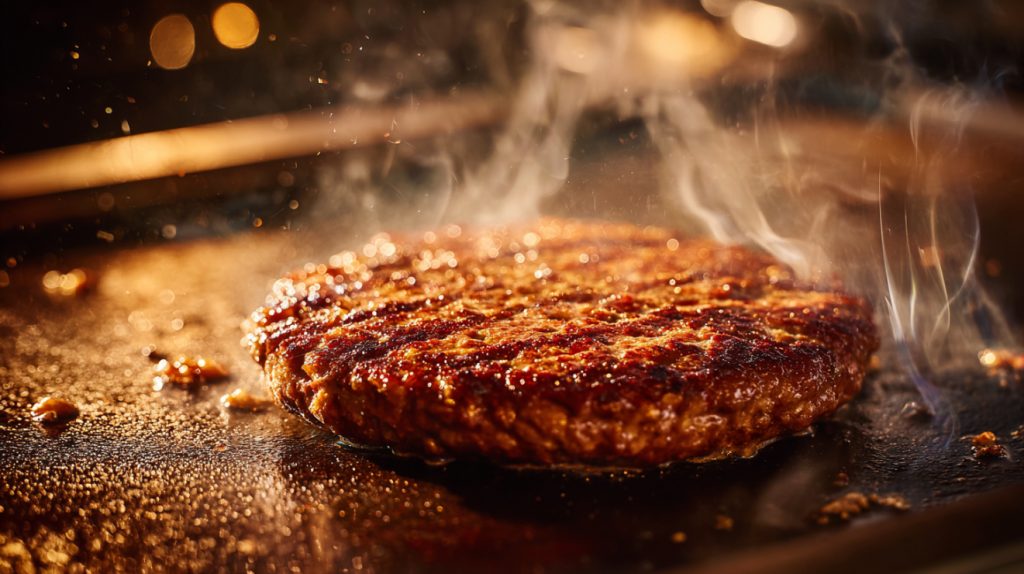
Then pull the parchment off and walk away from it. Do not touch it. Do not check the edge and do not press it again. Let it sit for 2 to 3 minutes while the crust builds. You will know it is ready to flip when you look at the edges and see that dark, lacy browning creeping all the way around the perimeter of the patty. At that point, the patty will actually release from the griddle on its own. If you have to pry it, wait another 30 seconds.
The Flip, the Cheese, and the Dome
When those edges are ready, flip each patty with one clean, decisive scrape. Get the spatula flat and low, slide it under the whole patty, and turn it in one motion. Do not hesitate or you will leave crust behind. The second side cooks faster — about 1 minute — because the rendered fat has already coated the surface.
The moment the patty is flipped, lay a slice of American cheese directly on top. If you are making doubles, let the first patty cook for 30 seconds, then place a second patty (already cheesed) on top of the first. Put your dome lid over the stack and add a small splash of water to the griddle just outside the dome. The steam this creates finishes melting the cheese in about 30 to 45 seconds. You will see the cheese go from solid to soft to glossy — pull them the moment they look glossy.
Toasting the Buns and Building the Burger
The buns should already be done — toasted golden in butter on the cooler side of the Blackstone while the patties were cooking. If they are not done, do them now on medium heat while the cheesed patties rest for just a moment off the direct heat zone.
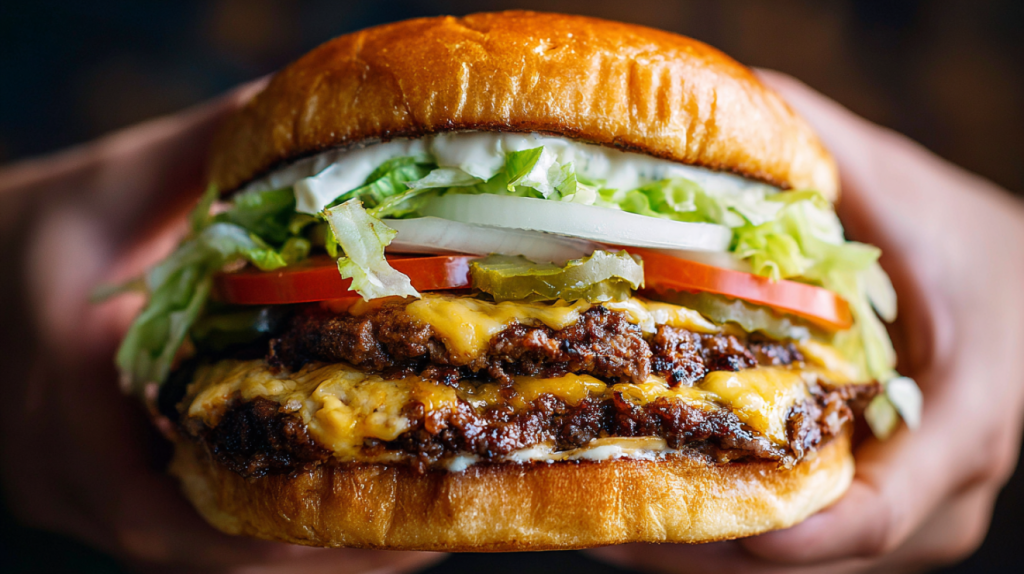
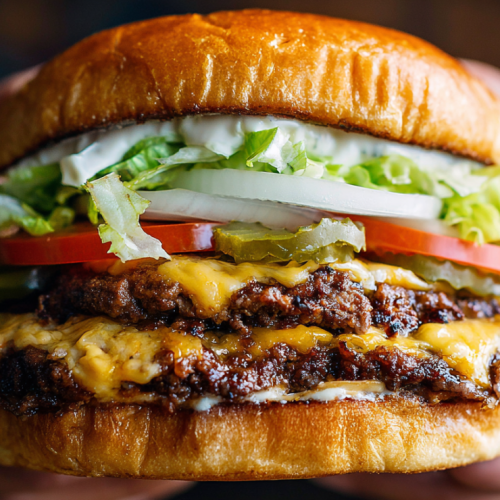
Smash sauce goes on both buns — a generous swipe on each. Pickles go on the bottom bun first, then the patty stack, then thin-sliced raw white onion, a tomato slice, and shredded iceberg. The cold crunch of that lettuce and onion against the hot, rich patty is exactly the contrast that makes a smash burger great. Put the top bun on and serve immediately. These do not hold. Eat them hot.
What to Serve Alongside a Smash Burger Cookout
A smash burger is a rich, bold, satisfying main, so the sides you pair with it should balance that richness rather than add to it. Thin, crispy fries or shoestring fries are the natural companion — they give you something to drag through extra smash sauce, and their lightness plays well against the weight of the burger. I like to fry mine right on the Blackstone after the burgers are done, in whatever seasoned oil and beef fat is left on the surface.
How to Make Southern-Style Potato Salad is another excellent choice for a larger cookout spread. Make it ahead, keep it cold, and it is ready the moment the burgers come off the griddle. The cool, creamy potato salad is exactly the right thing next to a hot, seared burger on a summer day.
For occasions, smash burgers are a natural for Fourth of July, backyard cookouts, graduation parties, or any casual outdoor gathering where you need to feed a crowd fast. The Blackstone lets you run four to six patties at once, which means you can knock out a dozen burgers in two or three batches without breaking a sweat.
Five Ways to Change Up Your Blackstone Smash Burger
The Bacon Smash
Cook your bacon strips on the Blackstone first, let them crisp up, and set them aside while you cook the patties in the rendered bacon fat. Add a strip of bacon right on top of the cheese before you dome it. The smokiness of the bacon gets into every bite, and using the fat to cook the patties takes the flavor up another level entirely. My son-in-law requests this version every time we fire up the griddle.
The Mushroom and Swiss Smash
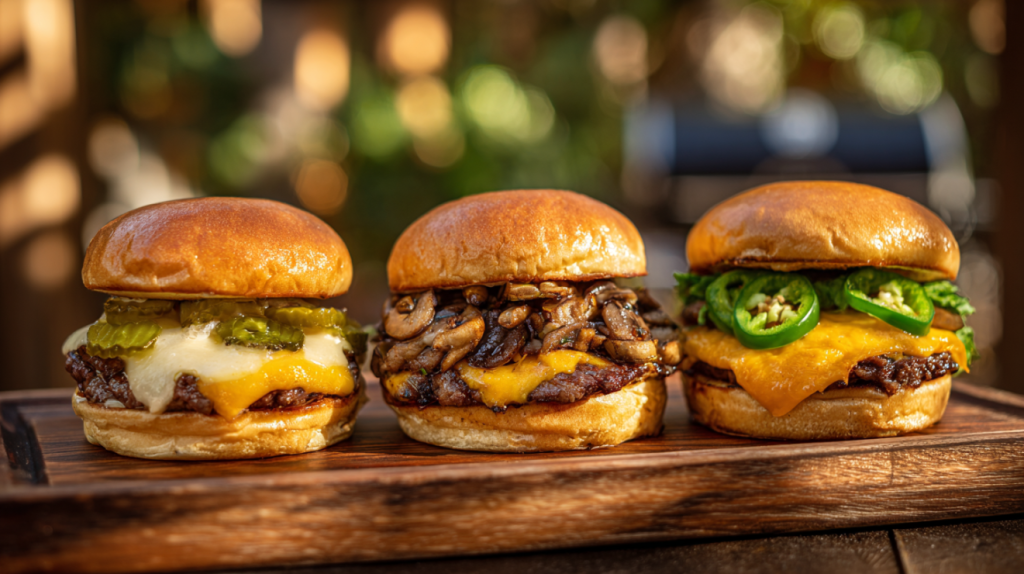
Sauté thin-sliced cremini mushrooms with butter and a splash of Worcestershire right on the Blackstone while the patties cook. Swap the American cheese for Swiss — it melts slower, so dome it a little longer — and pile the mushrooms on top. This one is earthy and savory in a way the classic is not, and it is the version I make when I want something that feels a little more dressed up.
The Spicy Jalapeño Smash
Mix a teaspoon of cayenne and a half teaspoon of crushed red pepper into the beef balls before you form them. Use Pepper Jack cheese instead of American. Add fresh or pickled jalapeño slices to the build. Swap the smash sauce for a chipotle mayo — just mix in a teaspoon of minced chipotle in adobo. This one has a real slow burn that builds with every bite.
The Patty Melt Smash
Instead of a brioche bun, use thick-cut Texas toast that you butter and griddle on both sides. Pile caramelized onions on top of the patty with Swiss and American cheese combined. Press the whole thing together like a sandwich and let it toast against the griddle for 30 seconds on each side to lock it all in. It is somewhere between a smash burger and a diner patty melt, and it is one of the best things I have ever made on a flat top.
The Oklahoma Onion Smash
Place a small pile of thin-sliced white onion directly on the hot griddle, then set your beef ball on top of the onions before you smash. When you press down, the onions get pressed directly into the beef and cook into the patty as it sears. The onions caramelize and soften into the bottom of the patty while the top gets its crust. It is a classic Oklahoma-style technique, and it gives the burger a deeply savory, sweet onion flavor throughout every bite.
Storing, Reheating, and Getting Ahead
Smash burgers are best eaten the moment they come off the griddle — there is really no way around that. A smash burger that has been sitting for 20 minutes is still good, but the crust softens as the moisture in the patty and the steam from the cheese works into it. That said, life does not always line up with a hot griddle.
If you have leftover cooked patties, store them separately from the buns, toppings, and sauce. Put the patties in an airtight container in the refrigerator for up to 3 days. To reheat, put them back on the Blackstone or in a cast iron skillet over medium-high heat for 60 to 90 seconds per side. Do not microwave them — they will steam and the crust will disappear entirely. A hot, dry pan is the only way to bring them back with any texture at all.
For make-ahead, you can form and season the beef balls up to 24 hours ahead and keep them covered in the refrigerator. The sauce keeps well in a jar or squeeze bottle for up to a week and gets better after the first day once the flavors have had time to come together. Slice your onions and tomatoes a few hours ahead and refrigerate them. Everything else takes minutes on the griddle, so the actual cooking will always be fast.
I do not recommend freezing cooked smash burgers — the texture suffers too much. If you need to freeze beef for this recipe, freeze the raw beef balls before seasoning, then thaw overnight in the refrigerator.
Six More Things to Do With Smash Burger Patties
Smash Burger Sliders
Use dinner rolls instead of full-size buns and scale the beef balls down to 1.5 oz each. Cook exactly the same way. These are perfect for parties where people want to taste multiple things — two or three sliders each, and everyone gets fed without committing to a full burger.
Smash Burger Salad Bowl
Skip the bun entirely and serve a double patty over a big bowl of shredded iceberg, sliced tomato, pickles, and thinly sliced red onion. Drizzle the smash sauce over the top like a dressing. You still get all the flavor of the smash burger without the bread, and it holds up better as a make-ahead lunch the next day.
Smash Burger Tacos
Smash a small, 2 oz ball of beef directly onto a small flour tortilla on the griddle, press it flat, and cook the whole thing — tortilla and beef together — until the beef is seared and the tortilla is slightly crisp underneath. Flip it once, add cheese, and serve with pickled jalapeños and smash sauce. This one went viral for a reason: it works.
Smash Burger Fried Rice
Chop leftover patties into bite-sized pieces and toss them into a wok or cast iron skillet with day-old rice, a beaten egg, soy sauce, sesame oil, and sliced green onion. Cook over high heat until the rice crisps slightly. It is a next-day lunch that uses every bit of that good beef and comes together in under 10 minutes.
Smash Burger Quesadillas
Lay a flour tortilla flat, add a crumbled smash patty, shredded American or cheddar cheese, pickled jalapeños, and a drizzle of smash sauce. Top with a second tortilla and cook in butter in a cast iron skillet until golden on both sides. Serve with extra smash sauce on the side for dipping.
Smash Burger Biscuit Sandwich
Split a cathead biscuit — the big, fluffy kind — and use it in place of the burger bun. The biscuit is rich and buttery and slightly crumbly, and it soaks up the smash sauce beautifully. Add a fried egg on top of the patty and you have got a breakfast sandwich that will carry you through the whole morning.
Blackstone Smash Burger
Equipment
- Blackstone Griddle or flat top griddle
- Heavy metal spatula (burger smasher)
- Burger press or second spatula
- Squeeze bottles for oil and sauce
- Dome lid or basting cover
Ingredients
The Patties
- 1.5 lb 80/20 ground beef divided into 3 oz balls
- 1 tsp kosher salt
- 1 tsp black pepper coarsely ground
- 1 tsp garlic powder
- 2 tbsp neutral oil avocado or canola
The Build
- 8 slices American cheese one per patty
- 4 brioche burger buns split
- 1 tbsp unsalted butter for toasting buns
- 1 cup shredded iceberg lettuce
- 1 large tomato sliced thin
- 0.5 white onion sliced paper thin
- 16 dill pickle chips
Smash Sauce
- 0.5 cup mayonnaise
- 2 tbsp yellow mustard
- 2 tbsp ketchup
- 1 tbsp dill pickle brine
- 1 tsp hot sauce Crystal or Texas Pete
- 0.5 tsp smoked paprika
Instructions
Make the Smash Sauce
- Combine the mayonnaise, mustard, ketchup, pickle brine, hot sauce, and smoked paprika in a small bowl. Stir until smooth. Taste and adjust — it should be tangy, a little sweet, and have a good kick. Set in the refrigerator until you are ready to build.
Prep the Beef Balls
- Divide the ground beef into 8 equal balls, about 3 oz each. Do not overwork the meat — just roll them loosely in your palm until they hold together. Season the outside of each ball with the salt, pepper, and garlic powder right before they hit the griddle.
Fire Up the Blackstone
- Preheat your Blackstone on high for 8 to 10 minutes. You want it screaming hot — around 450 to 500 degrees. Spread a thin layer of oil across the surface and let it shimmer before anything goes on.
Toast the Buns
- Reduce one side of the griddle to medium. Butter the cut sides of the buns and place them face-down on the cooler side. Toast until golden brown, 1 to 2 minutes. Remove and set aside — do not let them sit on the griddle.
Smash and Cook
- Place 2 to 4 beef balls on the hot side of the griddle, leaving space between them. Immediately place a square of parchment paper over each ball, then press down hard and fast with your heavy spatula or burger press. You want them smashed to about a quarter inch thin. Hold the pressure for 10 seconds, then remove the parchment.
- Season the top sides immediately with salt and pepper. Let the patties cook undisturbed for 2 to 3 minutes until the edges are deeply browned and lacy and the tops are no longer pink. Do not touch them. When you see the crust creeping up the sides, they are ready to flip.
Cheese and Stack
- Flip each patty with one clean, confident scrape — get all that crust. Immediately lay a slice of American cheese on each patty. If you are making a double smash burger, stack a second cheesed patty on top. Dome the burgers with a lid and add a splash of water nearby to create steam. Let them sit for 30 to 45 seconds until the cheese is completely melted.
Build and Serve
- Spread smash sauce on both the top and bottom bun. Layer pickles on the bottom bun, then the patty stack, then onion, tomato, and lettuce. Cap it off and serve immediately — smash burgers do not wait.
Nutrition
Rate This Recipe
Share This Recipe With The Ones You Love!Common Questions About Blackstone Smash Burgers
What temperature should the Blackstone be for smash burgers?
You want the surface at 450 to 500 degrees Fahrenheit before any beef goes down. That high heat is what creates the Maillard reaction and gives you that dark, flavorful crust. If the surface is not fully preheated, the beef will steam instead of sear and you will not get the crust you are after.
Can I make smash burgers without a burger press?
A heavy, flat metal spatula is all you really need. The key is pressing down hard and fast — with your full body weight if necessary — and holding it for 10 seconds. Some people use the bottom of a heavy skillet or a pot. Whatever you use, it needs to be flat, heavy, and able to take the pressure without flexing.
Why do my smash burgers stick to the griddle?
Two reasons: either the surface is not hot enough before the beef goes down, or you are trying to flip them too early. A properly hot griddle with a thin layer of oil should not stick. And once that crust forms, the patty releases on its own. If you have to fight to get it up, give it another 30 to 60 seconds.
How long do I cook smash burgers on each side?
After smashing, the first side needs 2 to 3 minutes undisturbed. After flipping, the second side takes about 60 to 90 seconds before the cheese goes on and you dome it. Total cook time from smash to plate is about 5 minutes per batch.
Can I use frozen ground beef for smash burgers?
Frozen beef balls are actually a technique some restaurants use — the very cold temperature helps them hold their shape during the smash. Thaw just enough to let the outside soften but keep them partially frozen in the center. Fresh or refrigerator-cold works perfectly well and is what I use at home.
What is the best cheese for smash burgers?
American cheese, without question. It melts faster than any other cheese and stays creamy and smooth instead of breaking into a greasy mess. In the 30 to 45 seconds you have between flip and pull, American cheese will be perfectly melted every time. Save the aged cheddar for something else.
Why do smash burgers taste better than regular burgers?
Surface area and contact. When you smash the beef flat and press every bit of it against a screaming hot surface, you maximize the Maillard reaction — the chemical process that creates hundreds of flavor compounds from browning meat. A thick patty has far less crust relative to its mass. A smash patty is almost all crust, and that crust is where all the flavor lives.
Make These Tonight — You Will Not Regret It
A Blackstone smash burger recipe is one of those things that seems deceptively simple until you make it for the first time and realize how much is happening in those few minutes on the griddle. The technique matters. The heat matters. The beef matters. But once you have done it once and you pull that first perfectly crust-edged, cheese-draped patty off the hot steel, you will have it in your hands for good.
Fire up that Blackstone, get it good and hot, and make these for someone you love tonight. Then come back and tell me how it went — I always want to hear. And if you are just getting started with Southern cooking and want to understand how all these techniques and traditions connect, A Masterclass in Southern Cooking Techniques: Frying, Braising & Smothering is a good place to spend some time.